Table of Contents
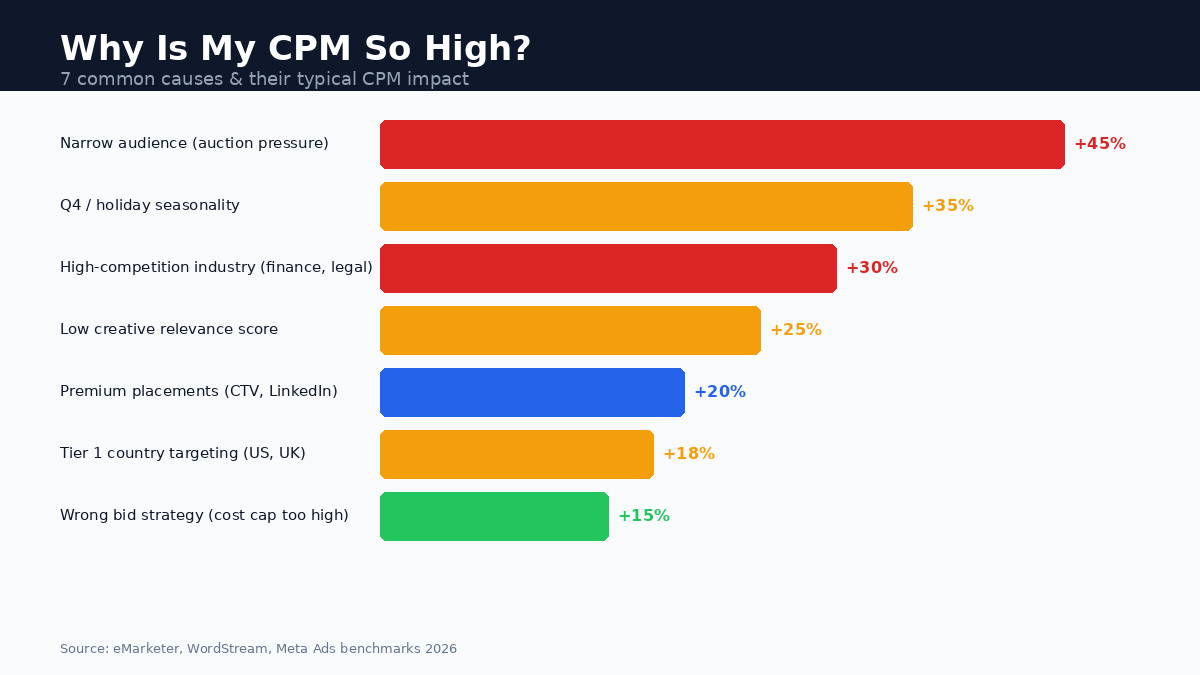
You opened your ad dashboard, saw a CPM 2x higher than last month, and panicked. Slow down. High CPM is rarely random — it is the output of an auction, and auctions respond to specific inputs. Change the inputs and the CPM follows. This guide walks through the 7 causes that account for 95% of "my CPM is too high" cases, in order of how often they are the actual culprit.
The 7 Causes at a Glance
| Cause | Typical CPM Impact | How Common |
|---|---|---|
| Narrow audience (auction pressure) | +30% to +60% | Very common |
| Q4 / holiday seasonality | +30% to +50% | Common (seasonal) |
| High-competition industry | +25% to +50% | Structural |
| Low creative relevance score | +15% to +30% | Common |
| Premium placements (CTV, LinkedIn) | +100% to +300% | Intentional |
| Tier 1 country targeting | +20% to +40% | Structural |
| Wrong bid strategy | +10% to +25% | Sometimes |
Sources: CPM impact ranges from eMarketer seasonal CPM data (Q4 spike analysis), WordStream Google Ads benchmarks (industry-level CPM variation), and Adamigo Meta Ads Benchmarks 2026 (audience size vs CPM correlation). "How Common" reflects frequency in media buyer support inquiries per Meta and Google advertiser help forums.
1. Narrow Audience (Auction Pressure)
This is the #1 cause of unexpectedly high CPM. When you target a small audience — say, 50,000 lookalike accounts with 5 interest stacked on top — you are competing for a tiny pool of impressions. Fewer impressions available + same number of advertisers bidding = higher clearing price.
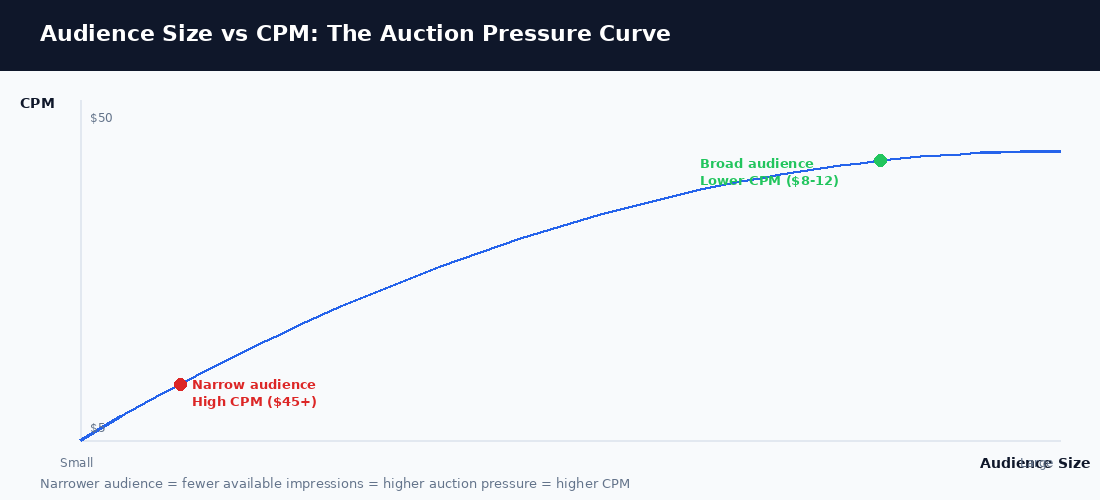
The math is simple: Meta's auction awards impressions to the highest bidder. If 100 advertisers are bidding for 10,000 impressions (broad audience), the clearing price is moderate. If those same 100 advertisers are bidding for 1,000 impressions (narrow audience), the clearing price is 10x higher. Source: Meta Ads Auction Overview.
2. Q4 & Holiday Seasonality
CPM is not constant throughout the year. It spikes in Q4 because every retailer, brand, and DTC company increases ad spend simultaneously. More demand, same supply, higher CPM.
| Period | Meta CPM vs Q1 Baseline | Google Ads CPM vs Q1 |
|---|---|---|
| Q1 (Jan–Mar) | Baseline (1.0x) | Baseline (1.0x) |
| Q2 (Apr–Jun) | +5% to +10% | +3% to +8% |
| Q3 (Jul–Sep) | +10% to +15% | +5% to +12% |
| Oct | +20% to +30% | +15% to +25% |
| Nov (Black Friday) | +40% to +60% | +30% to +50% |
| Dec 1–15 | +30% to +45% | +25% to +35% |
| Dec 16–31 | +5% to +10% | +0% to +5% |
Sources: Seasonal CPM data from eMarketer ad spending seasonality report and Adamigo Meta Ads Benchmarks 2026 (monthly CPM tracking across 45 countries). Black Friday week CPM spike confirmed by WordStream Q4 benchmark analysis. December 16–31 CPM drops because most advertisers have spent their Q4 budgets.
3. High-Competition Industry
If you are in finance, insurance, legal, or B2B SaaS, your CPM will always be high — and that is normal. These industries have high customer lifetime value, so advertisers can afford to bid aggressively. The auction clears at a higher price because the marginal advertiser's break-even CPM is higher.
| Industry | Google Ads Avg CPM | vs Gaming Baseline |
|---|---|---|
| Gaming | $4.50 | 1.0x (baseline) |
| E-commerce | $12.00 | 2.7x |
| Finance / Insurance | $17.00 | 3.8x |
| B2B / SaaS | $25.00 | 5.6x |
| Legal | $35.00 | 7.8x |
Sources: Industry CPM from WordStream Google Ads Industry Benchmarks (20+ industries, 46,000 accounts, 2026 data). The "vs Gaming" column shows the multiplier — legal CPM is 7.8x gaming CPM because a single legal case can be worth $10,000+ while a game install is worth $2.
4. Low Creative Relevance Score
Both Meta and Google use quality/relevance signals to adjust your effective bid. If your ad creative has low relevance to the audience (low click-through rate, negative feedback, "hide ad" clicks), the platform penalizes you by requiring a higher actual bid to win the same impressions. This shows up as higher CPM.
On Meta, this is reflected in your Quality Ranking and Engagement Rate Ranking diagnostics. If either is "Below Average" (bottom 35% of ads competing for the same audience), your CPM is being inflated by a relevance penalty. Source: Meta Ads Auction and Delivery.
5. Premium Placements (CTV, LinkedIn)
If your CPM jumped from $8 to $30 and you recently added Connected TV or LinkedIn placements, that is the cause — not a problem. CTV CPM averages $20–$42; LinkedIn averages $30–$60. These are premium inventory with premium audiences. The high CPM is the price of reaching decision-makers on a big screen.
This is an intentional cause, not a bug. But it becomes a problem if you did not intend to buy premium placements. On Meta, enabling "Advantage+ Placements" can opt you into Reels, Marketplace, and other placements with varying CPMs. On Google, Display campaigns can serve on premium publisher sites with higher CPM than the network average.
6. Tier 1 Country Targeting
US CPM is 10x India's. UK CPM is 8x Brazil's. If you recently narrowed targeting from global to US-only, your CPM will spike — not because anything is wrong, but because you moved to a higher-demand market.
| Country | Meta Avg CPM | Tier |
|---|---|---|
| United States | $16.00 | Tier 1 |
| United Kingdom | $14.00 | Tier 1 |
| Germany | $12.00 | Tier 1 |
| Brazil | $3.50 | Tier 2 |
| India | $1.50 | Tier 3 |
Sources: Country-level CPM from Adamigo Meta Ads CPM & CPC Benchmarks 2026 (45 countries, aggregated across all ad objectives). Full 45-country table on our CPM by Country benchmark page.
7. Wrong Bid Strategy
Your bid strategy affects CPM even when audience and creative are identical. The three common mistakes:
- Cost cap set too high — If you set a $50 cost cap on Meta but your actual CPA is $30, the algorithm bids aggressively to win impressions, inflating CPM. Lower the cap to $35 and CPM drops.
- Lowest cost without bid cap — "Lowest cost" strategy spends your budget as fast as possible, which means winning high-CPM impressions early. Add a bid cap to limit maximum CPM.
- Manual CPC on a CPM-optimized goal — If your goal is reach/awareness (CPM), but you bid on CPC, the algorithm optimizes for clicks, not impressions, and may pay higher CPM to get them. Match bid strategy to campaign objective.
Source: Meta Bid Strategy Documentation and WordStream Google Ads bidding guide.
How to Diagnose Your CPM Problem
When CPM spikes, do not guess — diagnose. Here is the 4-step process:
- Isolate the timeframe. When did CPM increase? Compare the last 7 days to the previous 30 days. If the spike started in late October, seasonality is likely. If it started after you edited an ad set, the edit is likely.
- Check what changed. Did you narrow the audience? Add a placement? Change bid strategy? Launch a new creative? The change that correlates with the CPM spike is your prime suspect. Meta's "Edit History" and Google's "Change History" logs show exactly what changed and when.
- Compare to benchmark. Is your CPM above the platform + industry + country median? Use our benchmarks to find your expected range. If you are at 1.5x benchmark, something is wrong. If you are at 1.0x benchmark and still unhappy, your expectation may be wrong.
- Test one fix at a time. Pick the most likely cause from the 7 above, apply its fix, wait 48–72 hours, measure. If CPM drops, you found it. If not, move to the next suspect. Do not change 3 things at once — you will not know which one worked.
Use our CPM Calculator to compute your actual CPM from spend and impressions, then compare it to the benchmarks.
FAQ
What is a "high" CPM?
A CPM is "high" when it exceeds 1.5x the median for your platform + industry + country combination. For US Facebook e-commerce, the median is $12–$16; anything above $24 is high. For US LinkedIn B2B, the median is $30–$45; $60 is high. See What Is a Good CPM in 2026? for full benchmarks.
Why did my Facebook CPM suddenly double?
The most common cause is audience narrowing (auction pressure). Check whether you recently reduced audience size, stacked more interests, or switched from Advantage+ to manual targeting. Other causes: Q4 seasonality (Nov), new creative with low relevance score, or accidental premium placement inclusion.
Does high CPM mean my ads are bad?
Not necessarily. High CPM on premium placements (CTV, LinkedIn) with high-intent audiences can be more efficient than low CPM on low-quality display. Evaluate CPM alongside CTR, conversion rate, and CPA. A $30 CPM with 5% CTR beats a $3 CPM with 0.2% CTR for any performance goal.
How much does CPM increase in Q4?
Meta CPM increases 40–60% during Black Friday week compared to Q1 baseline. Google Ads CPM increases 30–50%. The spike begins in October and peaks the week of Black Friday/Cyber Monday. Source: eMarketer. See Why CPM Spikes in Q4.
Can I lower CPM by increasing budget?
Counterintuitively, yes — sometimes. If your budget is too low, the algorithm enters high-CPM auctions to spend your daily budget quickly. Increasing budget 2x can let the algorithm find cheaper impressions over a longer delivery window. But if the root cause is narrow audience or bad creative, more budget will not help.