Table of Contents
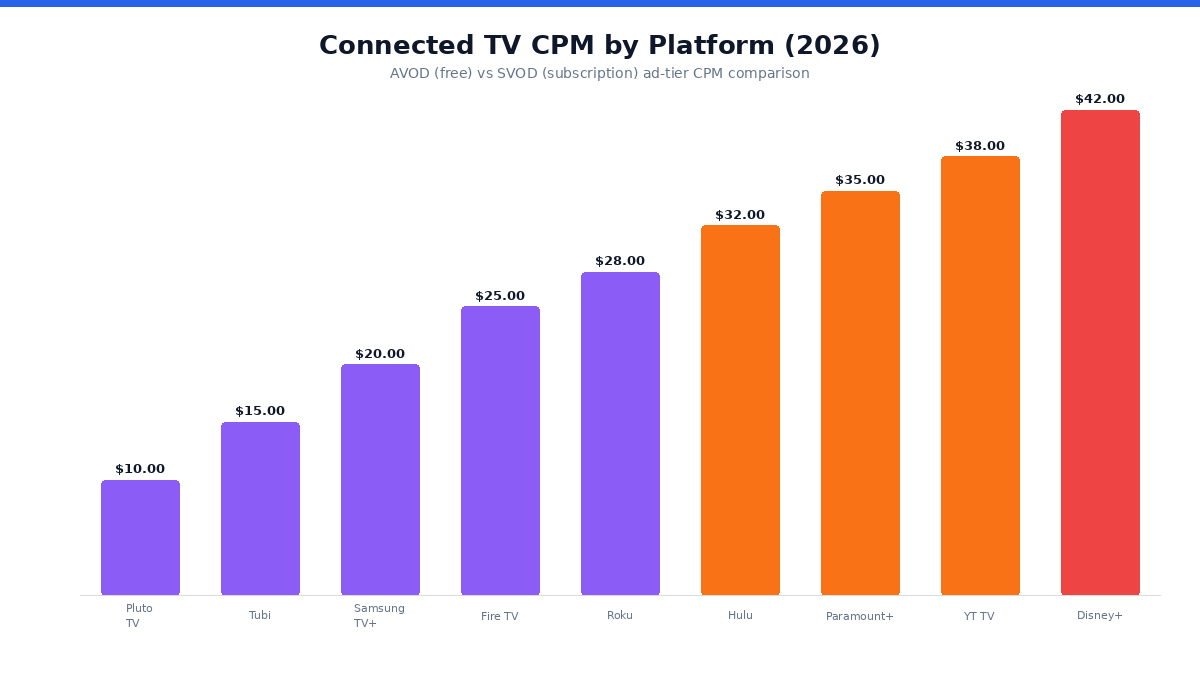
Connected TV is the fastest-growing segment of the US ad market. In 2026, US CTV ad spending reached $33.4 billion, up from $28.8 billion in 2025 and just $7.1 billion in 2020. That is a 5-year CAGR of 36%. But CTV is not one market — it is a fragmented landscape of 15+ platforms with CPMs ranging from $10 (Pluto TV) to $42 (Disney+). This guide maps every major platform, explains why the spread is so wide, and shows you how to buy efficiently.
What Is Connected TV?
Connected TV (CTV) refers to any television connected to the internet that can stream video content. This includes:
- Smart TVs with built-in apps (Samsung Tizen, LG webOS, Vizio SmartCast)
- Streaming devices plugged into a TV (Roku, Amazon Fire TV, Apple TV, Google Chromecast)
- Gaming consoles used for streaming (PlayStation, Xbox)
- Linear streaming services that replace cable (YouTube TV, Hulu + Live TV, Sling TV, FuboTV)
The key distinction from linear TV: CTV delivers ads via internet streaming, which means every impression can be targeted, measured, and bought programmatically. There is no Nielsen panel estimation — you get actual impression-level data. This precision is why CTV CPM is higher than linear TV despite smaller audiences: advertisers pay a premium for targetability.
CTV CPM by Platform (2026)
CTV CPM varies 4x across platforms. The primary driver is the monetization model (AVOD, SVOD, or hybrid), followed by audience composition and content tier. Below are US-average CPM figures for 2026.
| Platform | Model | Avg CPM (US) | CPM Range |
|---|---|---|---|
| Pluto TV | AVOD (free) | $10 | $8 – $14 |
| Tubi | AVOD (free) | $15 | $12 – $20 |
| Samsung TV+ | AVOD (free) | $20 | $16 – $25 |
| Roku Channel | AVOD (free) | $28 | $22 – $35 |
| Amazon Fire TV | Hybrid | $25 | $20 – $32 |
| Hulu (ad-supported) | Hybrid (AVOD+SVOD) | $32 | $28 – $38 |
| Paramount+ (Essential) | Hybrid | $35 | $30 – $42 |
| YouTube TV | SVOD + ads | $38 | $32 – $45 |
| Disney+ (Basic) | Hybrid | $42 | $36 – $50 |
Sources: CTV CPM benchmarks from eMarketer Connected TV ad spending forecast 2026 (platform-level CPM data). AVOD platform CPM from IAB Connected TV Playbook 2026. Premium SVOD/hybrid CPM from Innovid CTV Benchmark Report (Q4 2026 data across 400+ campaigns). Roku Channel CPM from Statista Roku advertising data. Ranges reflect the spread between low-competition dayparts and primetime inventory.
AVOD vs SVOD vs TVOD: Why CPM Differs
Understanding the three monetization models is essential to understanding CTV CPM. Each model creates a different advertising inventory supply, which drives different CPM levels.
| Model | How It Works | Ad Inventory | Typical CPM | Examples |
|---|---|---|---|---|
| AVOD | Free to watch, ad-supported | High volume | $10 – $20 | Pluto TV, Tubi, Samsung TV+ |
| SVOD | Subscription, no ads (or limited) | Very low / none | $35 – $50 (when available) | Netflix (ad tier), Disney+ Basic |
| TVOD | Pay per title, no ads | None | N/A | Apple TV (rentals), Vudu |
| Hybrid | Subscription + ads (discounted tier) | Moderate, premium | $28 – $42 | Hulu, Paramount+, YouTube TV |
Sources: Monetization model definitions and CPM ranges from IAB Connected TV Playbook 2026 and Innovid CTV Benchmark Report. The hybrid model (ad-supported tier of a subscription service) has become dominant since 2023, when Netflix and Disney+ both launched ad tiers. AVOD inventory grew 45% YoY in 2026 as FAST channels proliferated.
The economic logic:
- AVOD platforms need to fill more ad slots (more content, more ad breaks) so they sell inventory at lower CPM. Volume compensates for price. Pluto TV runs 4–6 minutes of ads per hour; Disney+ runs 3–4 minutes.
- Hybrid platforms have less ad inventory (subscribers see fewer ads) but higher-quality audiences (paying households have higher income). Less supply + higher demand = higher CPM.
- Pure SVOD (Netflix Premium, Apple TV+) has no ad inventory. The "ad tier" versions of these services are technically hybrid.
CTV vs Linear TV vs Digital Display
Media buyers often ask whether CTV is "expensive" compared to alternatives. The answer requires comparing CPM, reach, targeting, and outcome in the same frame.
| Metric | Linear TV | CTV | Digital Display |
|---|---|---|---|
| Avg CPM (US) | $25 – $55 | $10 – $42 | $0.50 – $8.00 |
| Targeting | Broad (age/gender, DMA) | Granular (1:1, behavioral) | Granular (1:1, contextual) |
| Ad completion rate | ~95% (can't skip) | ~85% (some skippable) | ~20% (scroll past) |
| Measurement | Nielsen panel (estimated) | Impression-level (actual) | Impression-level (actual) |
| Screen | 55"+ TV | 55"+ TV | Desktop / mobile |
| Min spend | $25,000+ (upfront) | $500 – $5,000 (programmatic) | $1 (self-serve) |
Sources: Linear TV CPM from Statista TV advertising data (US primetime average). CTV CPM from eMarketer. Digital display CPM from WordStream Google Ads benchmarks. Completion rates from Innovid Q4 2026 benchmark report (CTV 85% average across non-skippable and skippable formats; display viewability per IAB MRC standards). Linear TV measurement limitation per Nielsen methodology documentation.
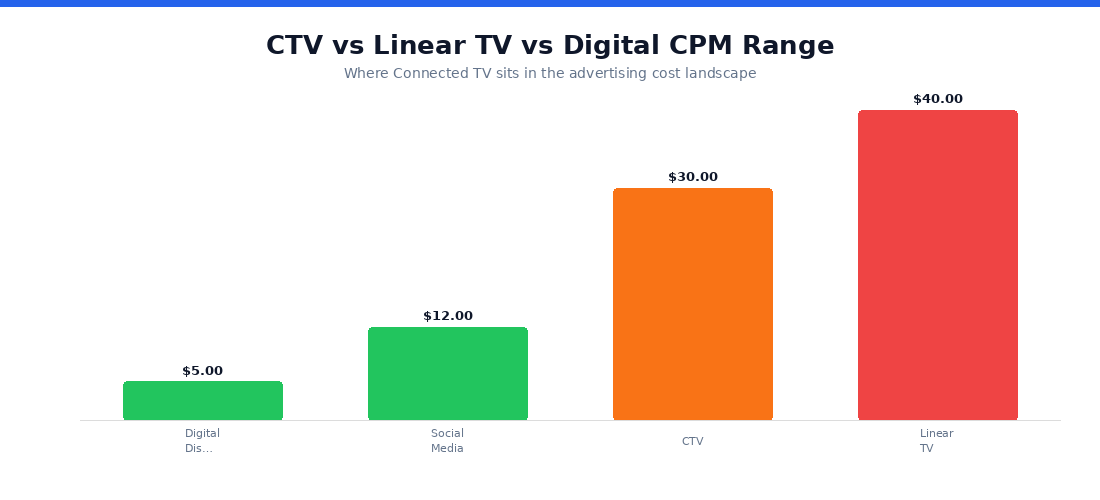
The takeaway: CTV sits in the sweet spot between linear TV and digital display. It has the big-screen impact and completion rates of linear TV, with the targeting and measurement of digital. Its CPM is lower than primetime linear TV ($10–$42 vs $25–$55) because there is more inventory and less upfront commitment. Its CPM is higher than display because a 30-second ad on a 55-inch screen during premium content is worth more than a banner on a website.
CTV Ad Formats & Their CPM Impact
Within each platform, the ad format you choose affects CPM. Here are the main formats and their relative cost:
| Format | Length | Relative CPM | When to Use |
|---|---|---|---|
| Standard spot | 15s / 30s | Baseline (1.0x) | Brand awareness, reach |
| Skippable spot | 15s + skip | 0.7x baseline | Cost-efficient reach |
| Non-skippable | 15s / 30s | 1.3x baseline | Guaranteed message delivery |
| Interactive / QR | 30s + interaction | 1.8x baseline | Direct response, engagement |
| Shoppable | 30s + product overlay | 2.2x baseline | E-commerce, lower-funnel |
| Home screen takeover | Static / video | 2.5x baseline | Launches, high-impact brand |
Sources: CTV ad format CPM multipliers from IAB Connected TV Creative Format Guidelines 2026 and Innovid CTV Benchmark Report (format-level CPM comparison across 400+ campaigns, Q4 2026). Interactive and shoppable format adoption data from eMarketer CTV ad format forecast. Home screen takeover pricing from platform direct sales team rate cards (Roku, Samsung, Amazon).
Most CTV campaigns still use standard 15s or 30s spots. Interactive and shoppable formats are growing fast (interactive ad spend grew 60% YoY in 2026) but remain a minority of total volume. The CPM premium for these formats is justified when you need lower-funnel action — a shoppable ad that drives a direct purchase is worth 2.2x a standard spot even at 2.2x the CPM, because the standard spot cannot drive that action at all.
How to Buy CTV Ads
There are three ways to buy CTV inventory, each with different minimums, CPMs, and control levels:
1. Direct Buy (Publisher IO)
You buy directly from the platform (Hulu, Roku, Disney+). Minimum spend is typically $25,000–$50,000 per quarter. You get guaranteed inventory, premium placements, and custom creative options. CPM is at the higher end of the range because you are buying guaranteed primetime inventory. Best for: large brands with big budgets who need guaranteed reach on specific content.
2. Programmatic / DSP (Open Marketplace)
You buy through a demand-side platform (The Trade Desk, DV360, Amazon DSP) connected to CTV supply via SSPs. Minimum spend can be as low as $500. You get granular targeting, frequency capping, and cross-platform reach in one buy. CPM is typically 15–30% lower than direct because inventory is non-guaranteed (remnant or open auction). Best for: performance-oriented buyers, SMB budgets, and campaigns needing cross-platform reach.
3. Private Marketplace (PMP / Programmatic Guaranteed)
A hybrid: you get access to a publisher's premium inventory via a deal ID, but transact programmatically. Minimum spend is $5,000–$10,000. You get guaranteed inventory (like direct) with programmatic targeting (like open). CPM sits between direct and open. Best for: mid-size brands who want premium inventory with targeting control.
| Method | Min Spend | CPM vs. Direct | Targeting | Guarantee |
|---|---|---|---|---|
| Direct IO | $25k–$50k | Baseline | Limited | Yes |
| PMP / Deal ID | $5k–$10k | 0.9x baseline | Full | Yes |
| Open programmatic | $500 | 0.7–0.85x baseline | Full | No |
Sources: CTV buying method benchmarks from IAB Connected TV Programmatic Guide 2026. Minimum spend thresholds from platform rate cards and Innovid buyer survey. Programmatic CPM discount vs. direct from eMarketer programmatic CTV forecast (70% of CTV ad spend is now programmatic, up from 55% in 2024).
Why CTV CPM Is Rising
CTV CPM has increased ~12% per year since 2023. Three forces are driving this:
- Demand is growing faster than supply. Ad spend grew from $21B (2024) to $33.4B (2026), a 59% increase. Ad-supported inventory grew ~45% in the same period. When demand outpaces supply, CPM rises. Source: eMarketer CTV ad spending forecast.
- Premium content migration. Sports and live events are moving to CTV (NFL on Amazon Prime, NBA on NBC/Peacock starting 2025, MLB on Apple TV+). Premium live content commands the highest CPM because it has the largest concentrated audience. Source: Statista sports streaming data.
- Measurement is improving. As CTV measurement matures (TAM 2.0, Video Nexus, Nielsen ONE), advertisers gain confidence that impressions are real and measurable. This confidence increases willingness to bid higher. Source: IAB CTV measurement initiatives.
The trend is expected to continue through 2028, with CTV CPM growing 8–10% annually as linear TV budgets shift to CTV and the supply of premium ad inventory remains constrained.
FAQ
What is the average CPM for Connected TV?
The US average across all CTV platforms is approximately $25–$30 in 2026. This ranges from $10 (Pluto TV, FAST channels) to $42 (Disney+ ad-supported tier). Source: eMarketer CTV ad spending forecast.
Is CTV CPM higher than linear TV?
Not necessarily. Linear TV primetime CPM averages $25–$55; CTV averages $10–$42. CTV is often cheaper than primetime linear TV, with better targeting. However, CTV is more expensive than digital display ($0.50–$8). Source: Statista.
What is the cheapest CTV platform for advertising?
FAST (free ad-supported streaming TV) platforms have the lowest CPM: Pluto TV at ~$10 and Tubi at ~$15. These are AVOD-only platforms with high inventory volume. Source: IAB Connected TV Playbook.
What is the minimum spend for CTV advertising?
Through programmatic buying (The Trade Desk, DV360), you can start with $500. Direct buys from publishers typically require $25,000–$50,000 per quarter. Private marketplaces sit in between at $5,000–$10,000. Source: IAB CTV Programmatic Guide.
How much of CTV ad spend is programmatic?
70% of US CTV ad spend is transacted programmatically in 2026, up from 55% in 2024. By 2028, eMarketer projects 80% will be programmatic. Source: eMarketer programmatic CTV forecast.
Should I use CTV or YouTube for video ads?
They serve different goals. YouTube CPM averages $5–$10 (cheaper, broader reach, more skippable). CTV CPM averages $25–$30 (more expensive, premium content, higher completion rates, big-screen viewing). For brand campaigns, CTV; for performance and reach, YouTube. Compare with our YouTube CPM Calculator.